


This big, beautiful military life doesn’t just shape where you live or how you plan your year; it shapes your nervous system. Over time, the common cycles of relocation, deployment, uncertainty, and constant awareness train the body to live in readiness, even when there is no immediate need. And the craziest part? Most of us don’t realize it’s happening!
When Readiness Becomes Your Default Setting
Your nervous system operates in two primary modes on any given day: sympathetic and parasympathetic.
Sympathetic (SNS), “fight or flight,” is activated when you sense danger. Whereas the parasympathetic nervous system (PSNS), “rest and digest,” is activated when you feel safe. “Your sympathetic and parasympathetic nervous systems have opposite roles. While your sympathetic nervous system carries signals that put your body’s systems on alert, your parasympathetic carries signals that relax those systems,” Cleveland Clinic, 2022.
In a healthy rhythm, the body moves between these states. But military families live inside a unique stress environment. Frequent relocation, unpredictable deployments, and the emotional labor of stabilizing home life, separately, seem manageable in the moment.
But collectively, they create sustained vigilance that quickly forms into stress.
The data reflects this strain:
- Up to 30% of post-deployment service members meet criteria for PTSD, anxiety, or depression (RAND Corporation, 2014)
- Chronic stress exposure is associated with long-term nervous system and cognitive changes (National Institute of Mental Health)
- Among military children ages 3–8, parental deployment is linked to a 12% increase in anxiety disorders and a 17% increase in behavioral disorders (Gorman et al., 2010, Pediatrics)
The interesting thing about stress is that it isn’t always dramatic; it’s often steady.
Slowly, you may notice:
- Feeling wired but exhausted
- Sleep that doesn’t feel restorative
- Hypervigilance becoming habitual
- Difficulty fully relaxing, even in calm moments
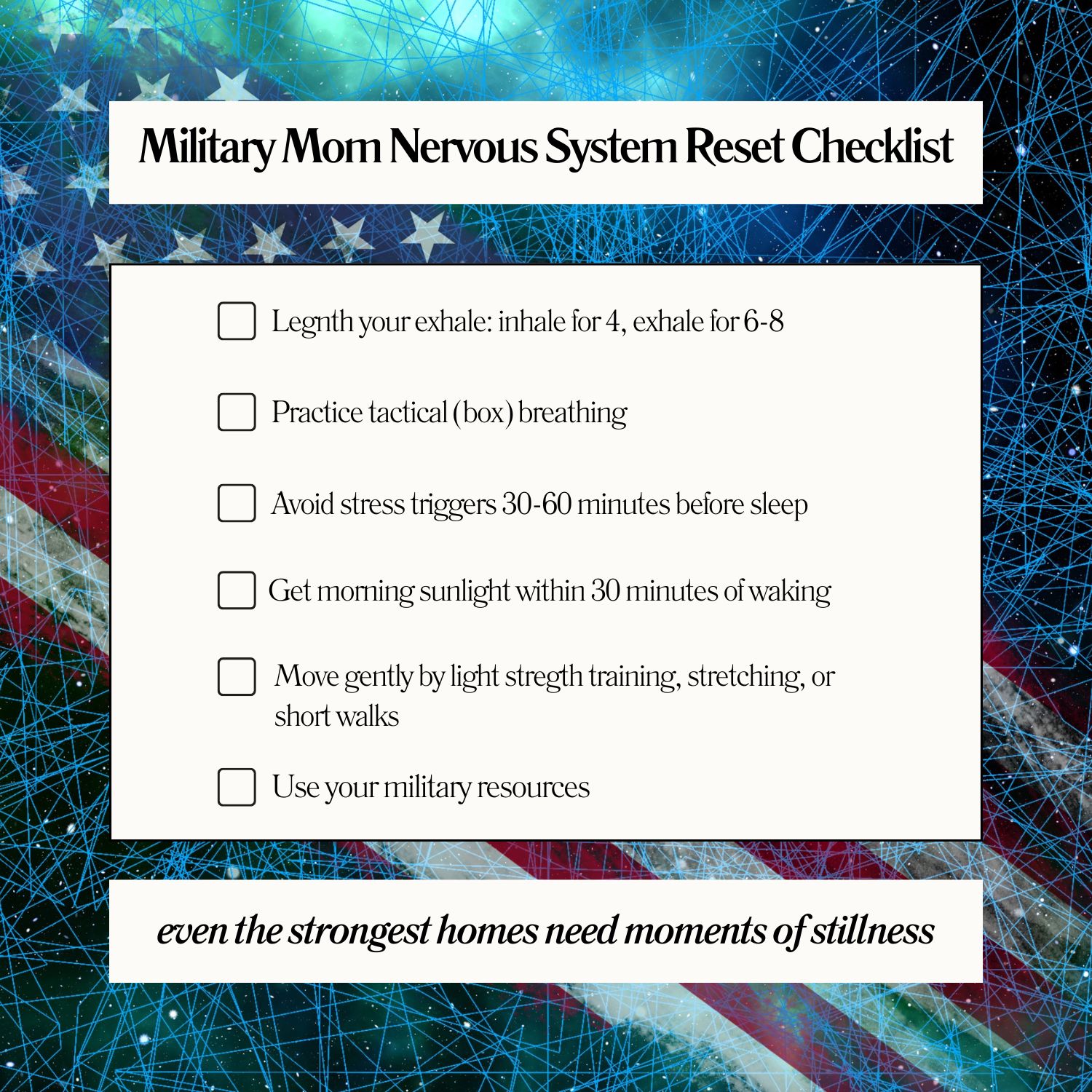
With readiness as our default setting, we can’t eliminate stress. But we can support ourselves enough to regulate it. Research on the autonomic nervous system and Polyvagal Theory (Porges, 2011) shows that activating the parasympathetic system helps restore balance.
1. Slow, Controlled Breathing
Tactical or box breathing has been shown to lower heart rate and reduce physiological stress markers; you can learn more about this technique in videos such as this one here.
2. Vagus Nerve Engagement
Extended exhales, humming, prayer or meditation, and safe social connections stimulate parasympathetic activation.
3. Consistent Reset Habits
Sleep, gentle movement, sunlight exposure, and supportive counseling all help recalibrate the nervous system over time.
When self-regulation starts to feel more challenging, there are specific military support resources to help! Below are some evidence-informed and confidential resources to help regulate yourself through the ups and downs of military life.
Military OneSource has free counseling and family support services for military members and spouses.
Military and Family Life Counselors (MFLC) provide short-term, non-medical counseling available on installations and via telehealth.
VA PTSD Family Programs are education and resources for families navigating deployment-related stress.
Understanding how the nervous system adapts to long-term stress changes the way we see ourselves. It explains why rest can feel uncomfortable after years of living on high alert. It explains why you might struggle to fully relax, even when everything is technically fine. Your body has been protective as it has learned to scan, brace, and prepare. Because military life required it to.
The goal isn’t to undo that strength that you’ve likely worked hard to create. But we do want to add something alongside it. We want to remind your body that not every moment requires readiness and that safety can exist in ordinary evenings, quiet mornings, and uneventful days.
Remember the goal? Balance. Seek that healthy rhythm.
If you’re seeking more ideas on how to regulate yourself and your environment during stressful times, check out Small Steps to an Organized Home.