



Human Trafficking in America
If you’re like me, there’s a good chance that up until a few years ago, you had no idea that human trafficking was taking place in America.
I’m not a journalist. Or a reporter. And I don’t even really like coffee, but I found myself eager to sit down for an interview with two world-changers at my favorite local coffee shop. Carl and Tina Kadolph own Palate Coffee Roasters in Sanford, FL. They are the founders of a business called Love Missions.
Love Missions seeks to abolish modern-day slavery and the exploitation of children around the world. That’s right. My local coffee shop rescues children from sex trafficking. And until my interview with owners Carl and Tina, I had no idea that my children had already been targeted, and so have yours.

For Tina, human trafficking is a very real and very personal issue. As a survivor, she is passionate about raising awareness, educating families, and providing much-needed resources and opportunities for other survivors. Being trafficked by her own mother at the tender age of 4 years old, Tina knows what it is like to hate life so much that you try to end it. She doesn’t want another person to ever feel hopeless, and so she endeavors to eradicate the evil of human trafficking in our country and around the world.
Tina knows that with the right help, victims can heal, develop healthy relationships, and create the kind of future they’ve only ever dreamed of.
At the age of 20, Tina met a man at a party who reached out to her as a friend. Tina didn’t trust any man at that point in her life and was hesitant to accept his friendship. After 35 years of marriage, Carl is not only her friend but he is also her business partner, mission partner, and healing partner as they worked through Tina’s trauma together. In addition to Carl, Tina attributes her relationship with God to how she was able to bring good from her situation, even though at the time she couldn’t imagine what that would look like. Tina believes it is the grace of God, the love of her husband, and the support of the community that have enabled her and Love Missions to become the driving forces they are in the fight against human trafficking.
Tina and Carl operate two coffee shops. They also have an ice cream and bubble waffle shop that has just opened. All the baristas are volunteers, so that all profits can go directly to the work of Love Missions. They have a safe house in Guyana and one due to open in South America before the end of the year. They are also working to open a Life Center in Central Florida to help victims learn life skills, receive counseling, and delve into therapeutic outlets such as sewing, dancing, painting, and even connecting with an emotional support dog. Survivors will be taught how to become successful entrepreneurs (if they wish to go that route), create stellar resumes, and how to dress for success. The back portion of the ice cream and waffle shop, Palate Bub’s and Ice Cream, houses a full commercial kitchen where survivors will learn how to cook and bake from professional chefs and bakers, giving them important job skills and life-changing opportunities.
“There are more than 13,700 homeless kids in our tri-county area and Florida ranks third in the nation for human trafficking cases. We help alleviate poverty and bring awareness to the injustice of human trafficking,” according to their website. “One way Love Missions meets needs is by giving Christmas presents to local children.”
The Kadolphs are passionate about giving survivors the tools and resources they need to rebuild their lives and become successful, thriving individuals, able to accomplish anything they set their minds to.
Social media has helped organizations such as Love Missions and Rapha House spread awareness and offer a call to action, yet there is still so much that I didn’t know that I didn’t know. Maybe you’re diligent like I am in keeping the conversation open with my children about child predators, never talking to strangers, and only engaging with people they know on their phones… but what if that’s not enough?
If you’re like me, this list is for you.
7 Things You Probably Didn’t Know About Human Trafficking
#7- Pedophiles and traffickers can message your children through YouTube.
I seriously didn’t know this was a thing, and Tina didn’t know either until her 2-year-old grandson was watching Paw Patrol on YouTube on her phone and a message popped up asking, “How are you?” Tina looked into it further and so did I. Thankfully, YouTube has become aware of the problem and has been pressured to do something about it. In June, they began removing the commenting feature on many of their children’s videos. The Google-owned social video platform offers tips for protecting your children in this free e-book and provides step-by-step instructions on how to turn off the commenting feature.
#6- Human trafficking doesn’t just happen in big cities.
Not only is it happening in our country, but it’s also happening right here in our own backyards. It’s happening in small-town America. It’s happening around your base and happening right under our noses. Tina explained to me what the dark web is and how traffickers are able to log on and shop for children, much like you and I shop for new shoes. Your town probably has a list of available children and women that can be purchased for labor and/or sex right this very minute on the dark web. Mine does. And it sickens me.
#5- Boys are trafficked, too.
The movies tend to show women in Cambodia or little girls in Bangladesh being ripped from their homes and forced into slavery, but the truth is that little boys are trafficked, too. Tina says that boys are even more difficult to rescue and rehabilitate because they tend to be more embarrassed and harbor shame, which prevents them from coming forward to seek help. While the Polaris Project identified boys only making up around 10% of the survivors who came forward in 2018, every family needs to be aware that their children are targeted regardless of their gender.
#4- Traffickers can be doctors, lawyers, and CEOs, too.
With the sex trafficking charge of financier and convicted sex offender Jeffrey Epstein, the world learned that traffickers aren’t always the stereotypical pimps or creepy, gawky men with handlebar mustaches driving white vans or perverts living in their mother’s basement. They are frequently doctors, lawyers, CEOs, and men of great financial means who often hire others to do the dirty work for them.
#3- Foster care children, immigrants, and refugees are at greatest risk for becoming victims.
This statistic breaks my heart, and I’m not afraid to say that it should break yours, too.
It’s no surprise that the most vulnerable among us are most often victimized. Still, it crushes my heart to think that women, teens, and children who have recently lost their homes and are trying desperately to make their way in this world are the ones most likely to be sold into slavery in America, the land of the free, home of the brave. What sickens me even more are Tina’s stories of foster care group homes and individuals responsible for caring for our most vulnerable, who are so weak and cowardly that they choose people who have already been victimized to become their victims of human trafficking.
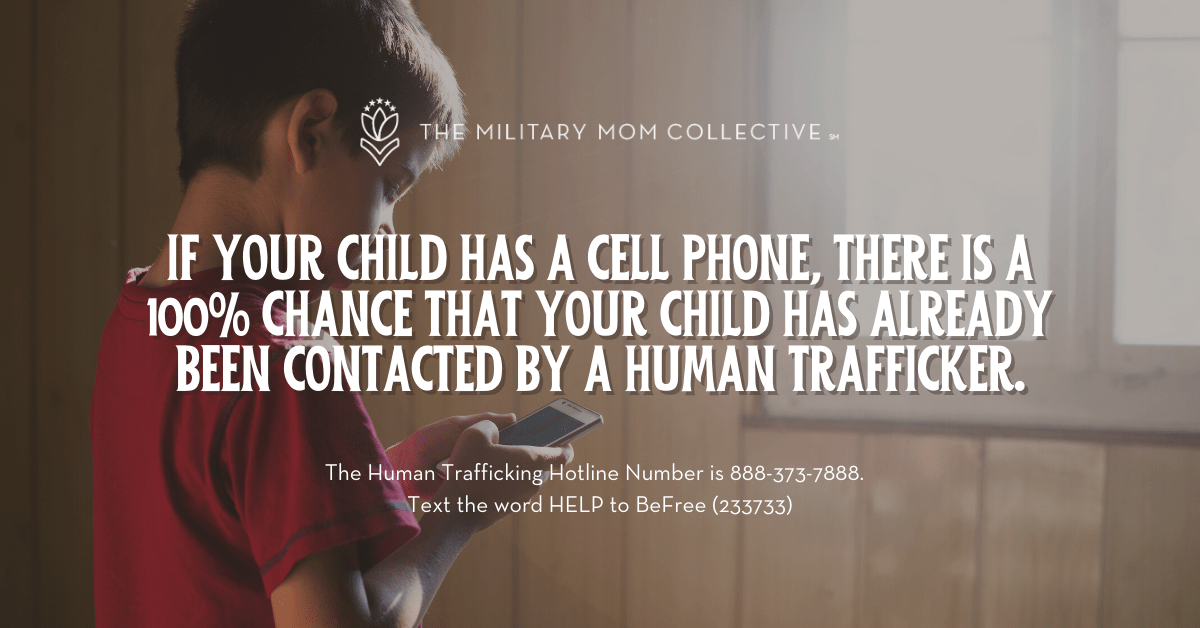
#2- Your child has already been targeted by a human trafficker.
A FBI agent once told Tina that if your child has a cell phone, there is a 100% chance that your child has already been SEEN OR contacted by a human trafficker.
That seems completely ridiculous and utterly impossible … except it’s not.
With approximately 500,000 child predators online every single day, the reach is far. With the rise of influencers and overall presence of children and families on social media, as well as kid-centered online gaming platforms, these statistics might feel scary – but they aren’t that far-fetched: If your child has an online presence of any kind, they’ve been seen by a child predator at least once.
#1- Many children and teens are trafficked “in plain sight.”
Of all the startling realizations on this list, this one sucker-punched me the hardest. Being a mama of five, I cannot imagine finding out that this had been happening to one of my own. “In plain sight” cases occur, as Tina explained, when a child or teen is targeted through social media or gaming. Over days, weeks, or even months, a victim is groomed by predators pretending to be a child of a similar age. FBI agents have told Tina that these predators go to great lengths to engage with children, to the point of wearing adult diapers while engaging online so that they never even have to step away to use the restroom. These predators are committed to making our children trust them. Why? Because traffickers can make anywhere from $250,000 – $600,000 a year for each child they “own.”
It starts innocently, and it will carry on until the trust that has been built up is significant. Children unknowingly give away private information such as their name, address, or school name. Predators then arrange to meet with them at the playground, down the street, or in some other manner, and the child is never seen again.
With teenagers, predators use both social media and even in-person encounters in the community or at their place of employment to gain their trust. Predators often hire younger, good-looking individuals to lure them in. When they find a girl they deem as vulnerable, they convince her to start sexting and sharing pictures or videos of herself. Then they turn it around and blackmail the girl. Sometimes they go as far as threatening the girl’s family if she doesn’t cooperate. These are the girls (and sometimes boys) who end up on the dark web’s shopping list. These victims can be purchased by the hour, and their traffickers arrange for them to be delivered to hotel rooms and other meeting places. What started as a social media infatuation or coffee house crush quickly escalates into the biggest mistake of the girl’s life.
These victims who are trafficked “in plain sight” carry shame and fear and feel they have no option but to do as they’re told. They’re often good girls who go to your kids’ school, or your church, or live in your neighborhood. They’re not usually the girls living on the streets that you “expect” to get “caught up” in such a lifestyle. They are girls who are loved. Cared for. Respected.
If you or someone you know has been a victim of human trafficking, it is never too late to get help and healing. The Human Trafficking Hotline Number is 888-373-7888. You can also text the word HELP to BeFree (233733) anytime.
What You Can Do To Protect Your Children
- Become informed. Completely informed. Even when it disgusts you, keep reading. The bad guys are always finding new ways to infiltrate the barriers we put up, so be vigilant in learning about ways to continually protect your children.
- Inform your children. I know it’s hard because you don’t want to scare them, but it’s important for our kids to know that it’s not OK to talk to strangers online – even strangers who say they’re the same age or who have a profile picture that makes them look the same age. Our kids are oblivious to the evil of this world and while we want to shield them from it, we still have an obligation to prepare them for the encounters online that are very likely to come. They should know that if they ever are approached, you’re on their side and that you will be ready to help them. Some kids will stay quiet because they don’t want to lose a game or app that they love. That’s why it’s so vital to clearly communicate the danger in a way that they will take seriously while also maintaining their trust.
- Ask your school, youth group, scout group, or neighborhood to get involved and get educated. There are organizations and programs ready to help.
- Practice e-monitoring of all of your children’s devices. Yes, I know that’s a lot of work. (I have 5 kids, remember?!) But the bad guys put in a lot of hours to steal our kids. We can put in the hours required to protect them. This means reading their texts and instant messages. But this also means looking at their apps. All of their apps. Even the seemingly innocent apps like their calculator, which, FYI, can be a fake messaging app.
- Know the signs of children who are being trafficked. If your child suddenly has new clothes, jewelry, shoes, etc that you did not purchase, they may be involved with trafficking. If your child has a phone that you didn’t purchase, this is a huge sign, as traffickers like to communicate through accounts that parents cannot see. If your child always has an excuse for where he/she “needs” to go, is overly tired (more than usual), is having trouble sleeping, becomes extremely emotional or emotionally shuts down, seems anxious and fearful, or just seems that something is completely wrong, you need to investigate further to make sure your child is not being victimized by a human trafficker.
- If you see something, say something. Do not hesitate to call the Human Trafficking Hotline or your local police department.
I know it might seem ridiculous to think that one of us could have a child who has been trafficked. Our minds just don’t work that way. Our hearts refuse to believe it could happen to us. To our precious kids.
But that doesn’t make it any less real.
As parents and grandmas and aunts and friends, we have the opportunity to protect ourselves and our children from the monsters of human trafficking. Our friends, our siblings, our children, and the vulnerable among us deserve to be protected.
I’m ready to let it start with me. Are you?